
Paris and Normandy

notre_damearccliffsNovember 18, 2014

After returning from Europe two weeks ago, I wrote only about our trip to Versailles and our gaffes at the airport security for which Robert paid the price. Those were difficult times for Robert and thus for me too. Robert’s reactions, although to some degree predictable, resulted from his specific understanding of rules, and his lack of ability to communicate efficiently under stress. With some reluctance, I have to say, that those reaction were disability related.

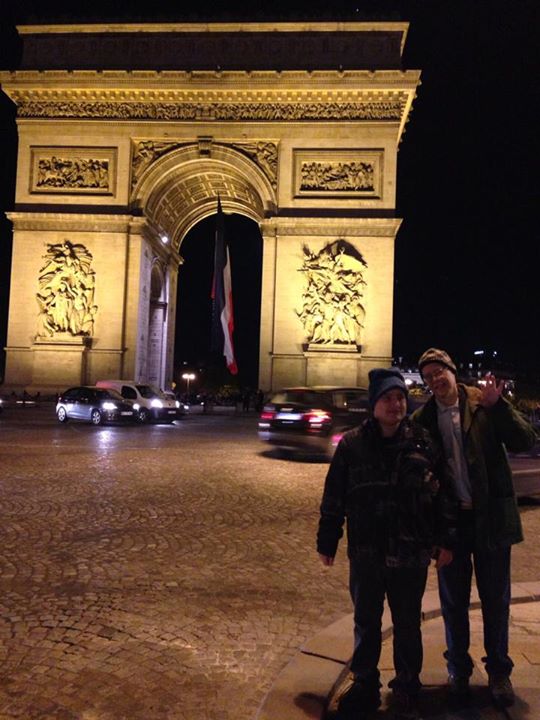
I haven’t written about our evening walks along Seine River to Notre Dame and back to Gare de Lyon.  I haven’t written about Robert’s walk from L’arc de Triumphe to Eiffel Tower which included a few rides on merry go round.  I haven’t written about Beauvais Cathedral or the cathedral in Bayeau.  I didn’t write about night walk to Mont Saint Michel  and another one we took the following morning not before we bought two umbrellas. Up and down the stairs to and through the Monastery. I haven’t written about climbing Cliffs in Etretat or stopping at Granville to look at the Ocean. I haven’t written, because Robert was doing exactly what everybody else in our group was doing. Walking up and down through the Monastery, looking at never-ending cathedral ceilings, rosettes, and tall, colorful windows, one above the other.

I didn’t write about Robert, because I did not pay any special attention to him.  He didn’t need our attention.  He let us see for ourselves and he was seeing everything for himself.  He was engrossed in the changing surroundings the same way, each of us was. I didn’t notice any idiosyncrasies that would make Robert’s reactions different from ours. I also refrained from directing Robert’s attention toward specific objects.  I am not sure there was a need to do just that.  Robert had a right to absorb everything in his own way. And so he did. It was a beautiful trip, almost magical.  We all felt that.

Robert didn’t mind being squeezed at the back of the car with his sister and me, while Alain or Robert’s dad drove for hours.  Robert somehow knew that at the end of the trip there would be something to see and the hotel to sleep in. And that hotel might even have a swimming pool.
Surviving Versailles, Healing in the Laundromat

November 11, 2914
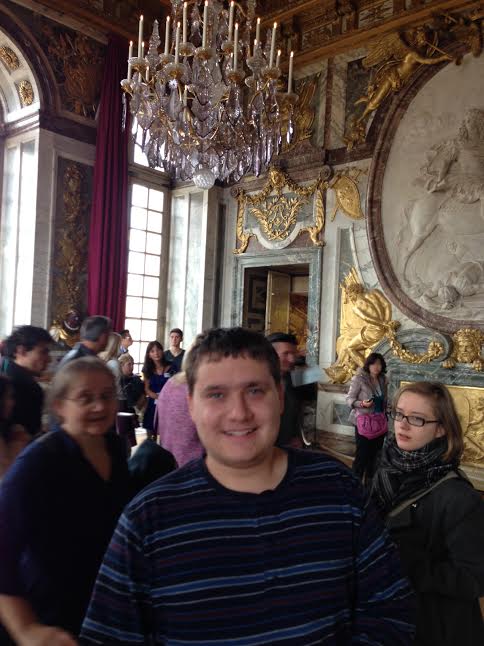
Robert in Palace
The picture of Robert taken in the Chateau de Versailles shows a person who finds this new experience clearly enjoyable.
Except this is not how I recall Robert’s visit to the Chateau. As we walked from one room to another, surrounded by a huge crowd, I remember Robert repeating, “Airplane, airplane.” or “Applebee’s, Applebee’s”. I interpreted those callings as a wish to return home and to find a good place to eat. Robert, in my opinion, felt overwhelmed by the slowly moving crowd, blocking the most interesting views. He was also very disappointed with French cuisine, that left his food untouched on the plate and his stomach empty.
I have to say, I didn’t expect that reaction. After all, a year or so ago, we visited a few large mansions in Newport, RI and Robert seemed to like those visits a lot. But then, those mansions were not crowded to the point that limited the view. The impression one might form while entering spacious, tall, richly decorated, airy spaces was gone when those spaces were filled with people.
It was hard to direct one’s attention from backs of the people in front to anything in the chambres. But I tried.
-Airplane, airplane.-
-Airplane on Tuesday.-
-Applebee’s, Applebee’s.-
-Applebee’s next week in Boston. We are in Versailles now. We see paintings on the ceiling. Painting on the wall. Huge mirrors. Great chandeliers!
Paintings, chandeliers, mirrors, big windows. What do we see?-
-Paintings, mirrors, lamps- Repeated Robert as I kept pointing.
This sort of a dialogue repeated itself ten or more times with small adjustments taking into account presence of sculptures, canopies over beds and so on.
Only when we stopped to sit on sparsely placed benches by the windows, Robert was able to take a bigger breath and look contemplatively at what was in front of him. So was I and so was Jan. We all kept quiet for a change letting our eyes do the wandering.
As soon as we got up Robert began, “Airplane, airplane.” And I followed until the exit.

We didn’t see everything. I regret that. I do think that despite all his anxiety, Robert deserved to see more. I believe, that under different circumstances he would enjoy and learn a lot more in a calm, relaxed manner so well projected in his picture.

Luckily the following day, we found two important places in the close proximity of our hotel. One was Subway Restaurant where Robert ordered his foot long, toasted, Italian bread with cheese and pepperoni. The other was a laundromat where Robert washed our dirty clothes diligently separating white clothes from dark ones. That was something he was familiar with. From that point on he could stay in France, specially since the hotel had a nice swimming pool too.

Airplanes and Airports – Clarification

November 11, 2014

It had to be said, that all the commotion at the airport was not Robert’s fault, but mine and my husband.
It was Jan who forgot to take his belt with a metal buckle and his knee brace with a metal insert. Thus had to go three times through the security scanner. That event was not lost on Robert as he probably deduced that going back and forth through the security gate could be done freely. It was I, who didn’t take IPAD from the backpack and thus the IPAD and backpack had to go through the scanner again. Robert was not prepared for such development and ran back to retrieve both. Consequently, he had to go through the security gate again and then again as he had already his wallet in his packet. He didn’t want to part second time with the wallet, that was not what he did during any of the previous trips. It was not Robert’s fault that I had a metal container with cards from Super Duper School Company in my bag, which I didn’t take out and thus had to open the suitcase, which again distressed Robert. It was Jan, who ten minutes before our turn to enter the plane decided to buy candies for Robert and disappeared somewhere in the terminal causing Robert’s anxiety. That anxiety, calling rather loud, “dad, dad”,might have alerted security and cause additional pat down. The event, I have to say, Robert tolerated patiently and calmly.
I could say, that we were all stressed out with that first trip abroad with Robert. We were more focused on Robert than on us. I could say that. Still, it was our faults that caused all the unwanted commotions in the airports. Not Robert’s

Airplanes and Airports

November 6, 2014
Three days after our return home, I am still not able to put our experiences in perspective. Four airports and four planes.
I did not ask for assistance with Robert. I thought that our previous two airplane trips to California proved that Robert could manage going through security without really alerting anybody to his special needs.
Wrong!
While going through Security at Logan Airport in Boston was not a problem, the small airport in Beauvais, France was a completely different story.
Everything started well. Robert went through the scanner gate without a problem. Unfortunately, when the security personnel returned our green backpack for another screening as I forgot to remove Ipad from it, Robert ran back to retrieve it. I had to run after him knowing that nobody else would convince him to leave the bag for another screening. Reluctantly, he let the bag and the Ipad go through, but then he had to go through the gate again. Except he had his wallet already in his packet. So he had to leave the wallet. That seemed wrong to him, after all he did that before. He took the wallet out, but didn’t want to leave it. I don’t remember how I convinced him to place the wallet in the bin again. But he did and he went through the scanner himself. I went after him. He calmed down when everything was in front of him. First he got his wallet, then jacket. he took upon himself to place Ipad in my bag. He gathered all bins and placed them in the pile.
I learned my lesson and in the next airport in Katowice, I remove my Ipad promptly. There was a problem with my small suitcase as it contained a metal box with a set of cards from Super Duper School Company, but Robert didn’t mind me opening that bag as he didn’t care too much for its content.
Back at the Charles De Gaul Airport, for reasons that are completely mystifying to me, Robert was singled out for another pat down just before entering airport. He took it with stoic attitude. I didn’t. I was wondering what in Robert’s behavior could provoke that additional scrutiny. And the only thing that come to mind was Robert repeating “dad, dad” over and over when his dad disappeared for a few minutes to buy him candies. Robert was anxious, very anxious. I was mad that Jan chose this moment to look for candies and risking being late for boarding.
Anyway, Robert’s repeating, “Dad, dad”, didn’t seem a good reason for an additional scrutiny. But maybe anything that seems out of ordinary is a reason for a scrutiny.
Maybe in other countries, the airports’ employees are less familiar with travelers with autism.
After thinking it over, I am glad that I did not ask for assistance. At least I could find out what are the possible problems and, in case, we travel again, prepare Robert for them. I don’t regret not asking for assistance. I am not sure I would get an appropriate one.
As for airplanes, only during the first take off, Robert got scared. He held my hand and requested, “Home, home.” In a few second he relaxed. Maybe because the plane lower the angle of flight, maybe because the perspective of sleeping in a hotel with a swimming pool was worth a short period of discomfort.

Before the Trip

October 23, 2014
It was a difficult evening. I started packing for our trip to France and Poland. Robert was taking off some of the clothes from two suitcases. Maybe he doesn’t like them. Maybe he believes they should remain at home. Because I was already stressed with all other arrangements, I had very hard time trying to deal also with Robert’s ideas. There is still so much to do. Moreover, Robert got very bad eczema on his arms and face. I suspect that it was caused by diet ice tea. I bought it a few days ago believing that it would help Robert lose some weight, but I became paranoid and poured half of the bottle out. I feel tired. This blog shouldn’t be about me, but about Robert. Still, I feel exhausted and a little scared. Last three days, Robert was very anxious. I don’t remember when was the last time he was so anxious. He knew about the trip and was pretty excited about it but last few days were different. Maybe because his skin is very itchy. I don’t know. I give him the same medicines.
Oh well, I am scared to travel. I have been scared before. I was scared when we drove to California and back to Massachusetts. I was scared when we flew to California and back. At least now, Jan, Robert’s dad, is coming with us. But, we are going to different countries. I am to some degree afraid of how will Robert react and act, but even more so, how people in those countries will treat Robert. I know, more or less, what to expect in US. I know the range of attitudes that might surround Robert in America. I don’t know those attitudes in European Countries.
Still, not taking Robert was not an option. If he doesn’t travel with us, he won’t travel at all. Nobody else would take him. We are getting older, it would get harder for us to travel.
It is a family thing. I couldn’t keep Robert from visiting his sister in France and the grandparent’s home in Poland. But, I am afraid that this trip might uncover the disconnect between Robert and the world at large. The alienation that here, in the environment carefully constructed around Robert by caring people, has been reduced if not eliminated.
But…

Price for Being Nasty

October 17, 2014
Yesterday afternoon, Robert and I went to a supermarket. Robert used self check out. He ran the bar codes through the machine while I was packing the groceries.
Because the package of ground meat which was placed in a plastic bag didn’t scan, I took the plastic bag off the package and scanned it. There was also a problem with an eggplant. We took a plastic bag to look for a code, but we didn’t find it. Luckily, we found a picture on the screen, so we were able to weigh the eggplant and got the price. After we paid for everything, Robert wanted to take the plastic bag off the package of the ground meat. I protested. Robert was upset, but stopped removing the bag from the package but instead tried to remove the plastic bag from the eggplant. I stopped him again. I was very upset and scolded him, sort off. Robert was upset too. He made grunting noises all the way through the store. I scolded him again, but that made him even more upset and the noises increased.
The ride home was, however uneventful and very quiet.
But when we brought the shopping home, Robert took off both bags – from the meat and from the eggplant and switched them. Only then I realized that the bags were different. The one from the meat section had red letters printed on it. The bag from the produce section was plain. Robert noticed the error I made at the cash register and tried to fix it. I didn’t let him! He was unable to explain to me what was the problem, and I didn’t give him any chance.
Even worse, I scolded him as if he were doing something completely irrational.
I wonder how did he feel? Unable to communicate, being scolded for trying to do the right thing. He certainly felt angry. But what was worse, he must also felt helpless, alienated, and lonely. Maybe even betrayed by me. That realization is the price I pay for being nasty.

Fizz, Liz, and Theory of Mind

October 12, 2014

I failed to read any books on autism and Theory of Mind. Thus I am not sure if lack of ability to understand other people’s perspective is a characteristic of autism or a byproduct of mental retardation. I am not familiar with specific research on the subject – either methods or conclusions.
I don’t know if the research led to recommendation about possible treatment.
For the last few days, however, Robert tried to understand the other people perspectives with the help of Fizz, Liz, and Owen.
Although Owen is a giant while Liz and Fizz are hardly one inch tall, they, nonetheless, live on two identical islands with the same landforms, plants, and animals. But of course for Liz and Fizz, their island presents itself very differently than Owen’s island appears to him. Both islands were created by authors of Reasoning and Writing Part B and became tolls in understanding other people’s perspectives. As Owen exchanges letters with Liz and Fizz describing his environment, Robert is supposed to help Liz and Fizz describe exactly the same objects as seen from their, rather short, point of view. A series of lessons should lead to understanding of how the things that seem little for some people can appear to be huge for others. Robert reads, measures, compares, and writes the response from Fizz and Liz by replacing adjective “small” from Owen’s letter by “big” or “huge”. Yes, Robert writes almost automatically, but I am not sure he understands the concept.
We still have a few more units till the end of the story, and a few more chances for Robert to understand different perspectives, and a few more chances for me to understand Robert’s understanding.

October 13, 20014
Yesterday evening and this morning, Robert and I read and analyzed two stories from The Reading Comprehension Kit for Hyperlexia and Autism by Phyllis Kupperman. In a way, the two stories Sounds in the Big Woods and Wondering About the Big Woods supplemented Fizz, Liz, and Owen’s tales with an opposite idea. The idea that different characters, Cassie Coyote and Grace Givens (a girl), can perceive the world and act in it in a similar or “symmetrical” manner.

Who’s to Blame?

October 6, 2014

In October of the last year, I came to observe Robert in his “transition” classroom. The observation was scheduled a couple weeks in advance. I didn’t ask to observe any specific activities. The teacher chose the place, time, and the activity. He chose cooking – frying tortillas with slices of apples and cheese. By the time, the lesson was over, I was depressed.
It was clear, that the teacher didn’t think about the lesson plan, he didn’t specified goals, he didn’t think about clarity of instruction, he didn’t make general introduction. There were so many things that could be taught: safety rules, hygiene, names of utensils. I was bitter. I knew how much more the students would learn if I WERE their teacher. I would introduce a new vocabulary, I would not just write the steps on a white board, but repeat them with the students in a funny way using some mnemonic technique. I would have arranged the tables in a horseshoe shape around the one and only flat, electric burner. I would have students work at the same time on cutting apples and cheese, as there were enough of aides to assure safety. I would put cooked tortilla in the pile and pass them to the students at the end, so they could eat together while having sort of light conversation prompted by the teacher. That would be a great opportunity to increase social interactions among students.
Student after student approached the burner, put on gloves, too big and too slippery for this job, and using tiny knife sliced the apples and cheese. The gloves were making it hard. The small knife made it even harder. The student poured some oil on the burner (some too much, some too little), placed tortilla with apples and cheese on it, folded it, and later with the spatula tried to flip it over. It was not easy, the tortilla kept sliding off the spatula and off the burner. While one student was doing this, all the others watched and waited for their turn.
Of course, I could blame the teacher for not thinking about the goals or for using wrong utensils. But then, he wasn’t a cooking instructor. Moreover, he didn’t have any utensils to choose from. The classroom didn’t have a bigger knife or tongues to flip over hot tortillas. The classroom didn’t even have sink. The electric flat burner was there because the students didn’t have access to a real kitchen. Although new high school had a splendid kitchen, those students in transition program didn’t have an access to it. That was the wish of my town’s school committee and the high school principal. While the students in high school had an access to the kitchen, students in the Transition Program, those who needed that access more than anybody else, didn’t. They didn’t because they were clearly treated like second class students. They needed more. But for my town’s school administrators those students who need more, are less deserving. So could I really blame the teacher who had neither training in teaching cooking nor an access to necessary equipment?
Maybe a should blame sped director? No, I couldn’t because she was new in the district, just five weeks on a job. Should I blame the old sped director? No, I couldn’t because I know that she tried to bring the transition program back to the spacious rooms in a new high school building where fully equipped kitchen could offer more opportunity to learn. She couldn’t do it, because of the opposition from the high school principal supported by superintendent. Could I blame the director of the program? No, because I was told that he was the director only on paper and was not really involved. Could I blame members of the school committee for opening a classroom without providing any money for a proper equipment, not to mention curricula materials? No, I couldn’t because the high school principal assured them that the students in the transition program won’t need anything and no dollar would be spent on that classroom. Could I blame the principal for lack of concern for the transition students if two mothers of children with disabilities wanted just a place where their TWO children could get custodial sort of care. They didn’t need more academics, they wanted a place to hang out between outings to job sites. Job sites which were mainly found for those two students using mothers connections. Because those mothers were well connected. Could I blame mothers that they wanted to make their TWO children happy and didn’t want to force them into any more learning of academics or life skills as that could backfire? Could I blame the school administrators for avoiding spending money on a transition classroom when the money could be spent on after school sport and art program. Could I blame the whole school district for neglecting children in the transition program ? No I couldn’t because they stated that they didn’t get money from the town to provide necessary equipment. I couldn’t blame the town leaders because it was the Department of Education in Commonwealth of Massachusetts that year after year kept sending a message that the neglect of special education children can go without any negative consequences while the effects of teaching typical children as measured by standardized tests are important and could have unwanted consequences to the district (even parents scorn). Could I then blame Department of Education? No, because they insist that all of the districts have under Commonwealth Law some autonomy and do not take lightly any interference from the State…
Thus I am the only person to blame. I knew that the civil rights of the transition students with disabilities had been violated for years, and yet I have never filled a complain with the Office of Civil Rights.

Mixtures and Solutions on a Rainy Saturday

October 4, 2014

We haven’t gotten a message so we brought Robert to the Ridge Hill Reservation for a walk with members of his Walking Club. Nobody was there, because the meeting was canceled due to the expected rain. The precipitation had already started with a shy drizzle, but soon it changed into regular rain. Nonetheless, there was this wonderful autumn scent in the air so we decided to take a short walk along the loop just to breathe. And we did.
After returning home, Robert read the last of the six easy books about Superman (from Costco). They are so easy, that reading seems rewarding to Robert. Later, Robert and I studied together, mostly following the same curricula:
Changing metric units (Singapore Math).
Elements of basic deductions (Reasoning and Writing)
Vocabulary words.
Pronunciation exercises based on Becoming Verbal and Intelligible (That brought again a bout of bitterness, as yet again I realized that this was what his schools’ speech therapists should had done years ago, but....)
Scholastic Comprehension Skills (comparing and contrasting Mars and Venus, based on a very short paragraph.)
Naming 3 things wrong with each of two pictures (to practice speaking without verbal prompting.)
After a short break we did SCIENCE.
We mixed oil and water, flour and iron shavings, flour and black beans, water and lentils, tea and sugar, water and salt. We watched as sugar and salt dissolved themselves in their respective liquids. We observed oil always push to the top of the water. We used magnet to remove iron from the flour, we boiled a small amount of salty water in microwave and tasted the powder on the side of the glass. We used strainer to retrieve beans and lentils from their mixtures. After all of that we read texts from Real Science (grade 3) and Core Skills Science (grade 3) about …mixtures and solutions.
Both texts contained some of the words which Robert probably didn’t understand, but they also described almost all of the experiments Robert had just performed with me.
Robert was thrilled! Maybe that was the way, he was able to return everything to previous (well, almost the same) state – by recovering beans, lentils, and salt. Maybe it was the funny way, the oil kept returning to the top. Maybe the easiness with which he could remove almost completely iron shavings from the flour making it perfectly white.
But maybe, just maybe, Robert was happy because he experienced yet another connection between written world and world of things and deeds.
Later, Robert, his dad and I played Trouble together. Robert was relaxed. He clearly enjoyed the game, even though I won.

Adjusting to the Changing World

October 2, 2014
Many times, I have heard that children with autism do not like changes in their environment or their daily schedules. That might be true for many individuals with autism. It is certainly true with Robert. He scans every new place he enters, and from that time on, he attempts to prevent any changes. If he notices, for instance, that the keys are kept on certain shelf, he will always put keys on that place, no matter where he finds them.
I also many times heard the conclusion that many “specialists” on autism deduced from this observation. “Since the children with autism don’t like changes, their environment should remain as unchangeable as possible.” Thus, the specialists advise that the same activities in the same places should fill the days of children with autism.
Of course, complying with such suggestion would reduce even further ability of children with autism to adjust to changes, and consequently will result in limited opportunities to learn and experience new things.
That is what my son’s teachers in his first (private) school realized many years ago, and that is something that they and I have tried to address by introducing “controlled” changes to Robert’s environment.
The most important tool in moderating the environment is language. The problem is, that Robert’s language was and remains very limited. But it still can be used in very simple forms.
In his private school, Robert wanted always to sit in the same chair at the table. Moreover, he wanted all his classmates to sit exactly at the same places every day. That led to problems, because not everybody in the classroom would comply with Robert need for sameness. One of the ideas to remedy the situation was to introduce place mats with children names written on them, and move them around. Their placement was supposed to control where the children sat. Moving them around would result in children switching their chairs. Thus, not the past, rigid arrangement controlled this aspect of the environment but the words written on movable place mats. This was a huge step toward flexibility.
The words can introduce change, prepare children for it, and give them tools to deal with any alteration of their worlds.
Changes are part of life and thus arming children with autism with means that would allow them to accept and adjust to different arrangements of surrounding them space and time is a necessity.
Unfortunately, the public school, Robert attended for last eight years was not capable of similar programing. The mantra, that the environment should be as stable as possible to prevent discomfort of a child with autism ruled unchallenged. Consequently, only unpredictable alterations of Robert’s environment provided opportunity to practice adjusting to changes. But that not always goes smoothly.
Just today, Robert was riding a horse. It is and activity, he completed almost every week for last few years without any problem. But today, as I observed him, he stopped, pointed toward the entrance to the arena, and kept repeating something quickly and rather loudly. No, he didn’t scream, but he didn’t whisper either. It was clear, that he was agitated. I didn’t understand his speech but I guessed that there was something in the arena, that wasn’t there on any of the previous occasions- a chain in the doorway, separating arena from the rest of the barn. I knew, that Robert wanted it to be removed.
Conundrum.
Removing the chain to satisfy Robert was the last option to consider, because it was important that Robert learn to tolerate the chain on the door during his riding. Asking Robert to get of the horse, was not a good idea either, because it would signal to him that he did something wrong. And Robert hated that feeling. With the instructor’s consent, I promised Robert that the chain would be removed after he completes three more rides around the arena. After he circled the arena three times, the chain was removed. The lesson, by the way, was over too.
I know now what change Robert has to be prepared for before the next lesson. Now it is time to use words as a mitigating tool. I will talk to Robert about the chain in the entrance to the riding arena as something to be expected and tolerated. I hope, my words do the trick.